Filming has wrapped on the domestic blockbuster «Metro», the first full-fledged disaster film since «Crew»
Irina Lyubarskaya


Nine million dollars, six months of tense and uncomfortable filming, most of which the actors Sergey Puskepalis, Anatoly Bely and 11-year-old Anfisa Vistingauzen, who play the main characters, spent in darkness and in the water, with their main props being wetsuits and waders. By way of set dressing — several real subway cars in various degrees of disfigurement. There are complex sets specially built in Moscow, including a 120-meter full-size metro tunnel recreated in the Kashirka district, and a scale model of it at 1:3, for which an ingenious system with a pump was devised to precisely simulate the terrible hydraulic surge. Plus the Samara metro dressed up as the Moscow underground, which was besieged by hundreds of local residents eager to be in the crowd scenes at any cost, ignoring the honest warnings of the administrators that during shooting they would be wearing their own clothes and those would most likely be completely ruined.
Scary / Interesting
The «PROFIT» company has taken on a rare genre for our cinema — the disaster film — in order to compete for the viewer on the field fertilized by Hollywood. The view persists that our people stubbornly refuse to watch domestic films in theaters and can only be lured there with a sharp plot and large-scale filming, repeating the success of Bekmambetov's «Night Watch». Whether this will work, it is still too early to say. To finalize the special effects, additional filming will still take place in the «chroma-key pavilion», as well as editing, which in disaster films is often more important than the acting, and other post-production. The release of «Metro» is scheduled only for the end of next year.
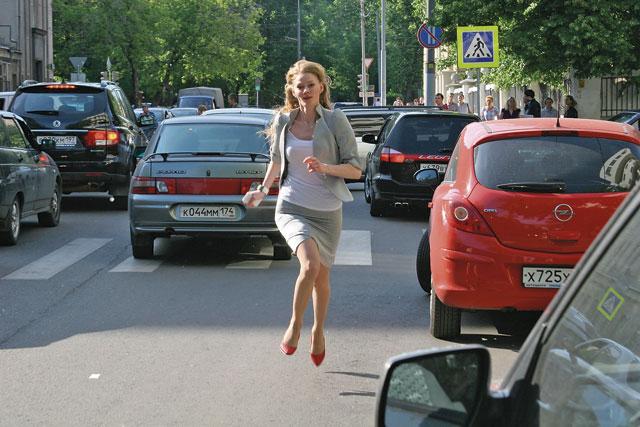
The story is actually quite authentic in its horror. The builders bungled something, miscalculated, and a crack appeared in the metro tunnel's arch, through which first seeped, and then broke through, the waters of the Moscow River. Dozens of people died, hundreds were injured, the threat hung not only over the underground but over the whole city. The heroes, by the will of fate, end up in one train — the very one struck by the disaster. A city hospital doctor (Sergey Puskepalis) was taking his daughter to some classes. His wife's lover, a former provincial now a Moscow high-flyer (Anatoly Bely), left his car in a traffic jam to make it to an important meeting. The wife herself (Svetlana Khodchenkova), a businesswoman of the new formation, will rush around the city with her mobile in hand as alarming news comes in, desperately wishing for a miracle — that all three people dear to her will be saved. And they, floundering in the water and trying to survive, must also decide how to go on living in this love triangle. In short, catastrophe or no catastrophe, all the same cherchez la femme.
The actors drew a difficult task, there's no denying it. After all, both Puskepalis («Simple Things», «How I Ended This Summer») and Bely (the Moscow Art Theatre productions «The Master and Margarita», «The Pillowman») are real stars of theater and cinema. Even if not so well known to the mass audience. They trail a train of signature roles, festival prizes, theater awards. On the one hand, filming demanded stunt feats from them. On the other — the viewer must be given heroes who can be humanly understood and sympathized with. And how to combine this?
Anatoly Bely, in a break between takes, also tries to tell us something about psychology, about people's relationships... But then it suddenly bursts out: «You know, these months, returning home, I kept catching myself thinking that I've had enough of water — I won't even take a shower! Why? I've got water treatments from morning to night as it is.» Sergey Puskepalis, sighing, admits: «I've already heard about our film that one shouldn't push a horror story on people — they're already afraid to go down into the metro, so much has happened there in recent years. But we are nevertheless trying to make a film not only about a disaster, but also about human relationships, about their fates. Now my hero, he is tired of carrying within himself the pain of a personal life gone wrong. The disaster itself somehow cleanses him of this accumulated negativity. And he commits, in relation to a person he should hate, completely paradoxical acts.»
The picture is based on the bestseller of the same name by Dmitry Safonov, which bloggers recommend reading at the very least to learn the rules of behavior in case of panic in the underground. It should be immediately noted that many confuse this «Metro» with the post-apocalyptic dystopia «Metro 2033» by another Dmitry — Glukhovsky, whose book, it seems, is also being eyed by filmmakers, but Hollywood ones. However, so far, this is only known from Glukhovsky's own words. So two horrifying stories about the Moscow Metro of the present and the future are not destined to meet in release. And it would have been striking...
As for Safonov, following the precepts of his beloved Stephen King, he has devoted his lyre to the nightmares of the residents of modern megalopolises — the collapse of a new-build elite high-rise («The Tower»), an ineradicable virus («Epidemic»). It is not hard to guess where the legs of these stories grow from: the plots are clearly Hollywood, the story development is also American-style crisp — here is horror-horror-horror to take the breath away, and here are heroes and human relationships that are clear to all, relationships which the surrounding horror only makes more vivid. Disaster without melodrama is a non-saleable commodity. Incidentally, Safonov does not hide that in his writing he is inspired by cinema. According to the film's director Anton Megerdichev («Shadow Boxing 2», «The Dark Side of the Moon 3D»), this orientation toward the overseas movie standard had to be fought. «We worked on the script for a long time,» says the director. «We had to concentrate, sharpen the conflict, compress the heroes into one place. We spent almost a year finalizing the story, and bringing all the scenery to a state resembling the reality of modern Moscow. Life in a big city is running in place. From eternal fuss, people commit ill-considered acts. They are constantly chasing after something — after something that depreciates every second, after money, after a spot at the traffic light. The megalopolis is made for those who like to elbow their competitors. It is a disaster city.»
Before and after «Crew»
At first glance it is rather strange that such a rich genre has been neglected by us for so many years. In Hollywood, since the '70s, its well-calculated profitability has been exploited, sometimes bringing a disaster film to the artistic level of «Titanic». And only the events of September 11, when the whole world saw how closely real horror can resemble a Hollywood shocker, imposed a long moratorium on the destructive genre. In Russia it is considered that «Metro» will be our first domestic disaster film since «Crew», which literally exploded the Soviet box office thirty years ago. Of course, disasters were attempted both before and after the legendary picture by Alexander Mitta. There was even a rather extravagant Cold War-era hit with a young Vysotsky as an American marine — «Flight 713 Requests Landing» (1962): about a plane flying across the Atlantic with a criminally sedated crew. But it was a film about the «decaying West». But catastrophic plots from our lives were not approved by Soviet power during stagnation. It is understandable why: one does not, as they say, point at oneself. However, it's not only about censorship. People still retained a genetic memory of the past — of revolution, repression, war, devastation. There were plenty of films on these subjects. But one can start playing with genre only when real pains become phantom ones.
«A disaster film,» reasons the executive producer of «Metro» Igor Tolstunov, «is not only a narrative about natural or man-made collapses, but also about heroes who in these extreme situations try to save themselves and their loved ones. It is precisely at such moments that their true nature is revealed, the deep qualities of human character are manifested. For us this is very important, and we are trying to present such a hero in the film «Metro».»
It is no wonder that the genre breakthrough occurred at the end of the '70s: that same «Crew» was something of a harbinger of perestroika. After it were made «The 34th Express» — about a fire on a train, «Anxious Sunday» — about a fire on a tanker, «Wingspan» — about an airplane's engines failing. And everything quickly came to an end. Either due to real troubles — Chernobyl and the sunken «Admiral Nakhimov». Or because in the USSR («Train Off Schedule») and Hollywood («Runaway Train») simultaneously filmed the plot of a train rushing out of control. It is scary to think that the film «Metro» may turn out to be prophetic. But Igor Tolstunov reassures: «The release of our film is scheduled for the end of 2012 — just when the end of the world is predicted. Therefore a metro leak against the backdrop of such a large-scale collapse looks like a mere trifle.»
In short, in our cinema, the disaster genre, like sex in the USSR, did not exist. And now it does. While «Metro» is being finalized, Timur Bekmambetov will already, before this New Year, show the destructive invasion of Moscow by aliens in the film «The Phantom».