Sergey Puskepalis: "Sooner or later, nerves can't take it"
Imagine what will happen to metro passengers if water from the Moscow River gushes into the tunnel. This, frankly speaking, catastrophic situation was depicted first in his novel “Metro” by the writer Dmitry Safonov, and then by director Anton Megerdichev ("Shadow Boxing-2. Revenge", "The Dark Side of the Moon"), who took on its screen adaptation.
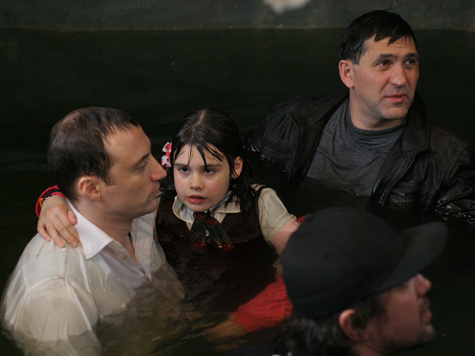
The actors have to spend 12 hours a day in the water
In the pavilion of the Gorky Film Studio — complete darkness. In the middle of the concrete floor stands a huge cube, inside which loud splashing and the frantic cry of a suffocating man resound, as if he is trying with all his might to fill his lungs with air while flailing his arms through the water. After shooting the scene, the lights were turned on in the pavilion. A pool, slightly covered with boards, filled with murky, sewer-like water, catches the eye. In the corner of the pool a corpse floats face down — one of a dozen mannequins that will play the role of drowned passengers in the picture.
The huge cube turns out to be a continuation of this same pool, but surrounded by high walls. This is now an underground bunker in which the surviving passengers are trying to save themselves. Inside, despite the tightness, there are director Anton Megerdichev, cinematographer Sergey Astakhov (who shot almost all of Alexey Balabanov's films) and the actors, among whom are the two main heroes of the film — Sergey Puskepalis (winner of the “Silver Bear” at Berlinale for his role in “How I Ended This Summer”) and Anatoly Bely. The director and the cinematographer are in tall rubber boots, and the actors — in whatever they happened to be wearing, soaking wet, and even with scratches and abrasions drawn on.
In exactly the same cramped space, only in a situation of direct danger to life, according to the plot, the film's heroes find themselves — closed-off, unknown to each other ordinary passengers who are forced to unite in order to survive. Just as it happened just now: an asthmatic girl lost her inhaler, and a young man who was seeing her for the first time in his life, risking himself, dived into the murky water and retrieved the inhaler. The beginning of a big and pure love, no less.
The overseer of all this apocalypse, Anton Megerdichev, says that he personally asked metro employees whether such a catastrophe is possible in the Moscow metro.
— They answered me: “This cannot be, but still sometimes happens”. Although in fact, something similar happened once in St. Petersburg. At that time metro construction workers accidentally struck a branch of the Neva underground, and a wild stream of water gushed into the subway. By a miracle the whole city did not go under. Our cinematographer Sergey Astakhov shot a documentary film “Breakthrough” about this in 1985.
— Do you destroy the cars for real?
— We will have models at a scale of one to three, but we will also smash a real train.
— I looked at the shooting schedule: there are constant broken arms and spines there, a woman pierced by rebar…
— There are two such shots for the entire picture. We will not savor the violence and injuries. We will try to achieve tension through the actors' performance.
As the director says, Puskepalis appeared in the film in a very simple way: “I saw the film “Simple Things” and was blown away”. Across the set Sergey, like the other actors, moves in a wetsuit over which clothes for the role are worn. But water still seeps in behind the collar.
— Sergey, don't you get claustrophobia in this bunker?
— For a long time I served in the navy, so I am fine with enclosed spaces.
— Your hero, as in your previous films, is again stern and taciturn?
— Not so much stern, rather closed-off, he keeps everything inside himself. This is also what gives rise to the conflict between him and the character that, in my opinion, Anatoly Bely plays wonderfully. His hero is the only one my character can call an acquaintance. And even this acquaintance cannot be called a pleasant one.
— Are you punching each other in the face on camera?
— We will have such an episode too. (Smiles.) Under stress, you know, sooner or later nerves can't take it.
material: Nikita Kartsev