The Russian film industry cannot exist without state money, most of which, since last year, is distributed among eight companies selected in a competition. About why the use of the new system will lead to the formation of domestic majors, Igor Tolstunov, the owner and head of one of these structures, the film company «PROFIT», told «Ko» in an interview.
Text by Anastasia Markina. Photographs by Alexey Sovertkov.
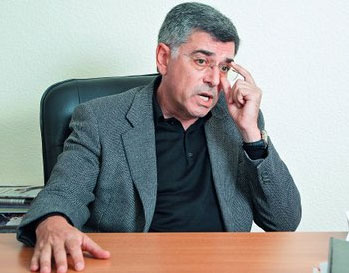
From 2010, a new program of distributing state funds allocated to support cinema began operating. Under this program, a specially created Federal Fund for Social and Economic Support of Domestic Cinematography allocates the bulk of state money to the market leaders, who then invest it in specific film projects. Among such structures, along with Nikita Mikhalkov's «TRITE» studio, Timur Bekmambetov's «Bazelevs» and other players, was the company «PROFIT» of Igor Tolstunov. Its credits include such high-profile films as «The Thief», «A Driver for Vera», «Piter FM» and «Everybody Dies But Me». As a result, «PROFIT», like the others, received 250 million rubles from the state in 2010, which it was to invest in current projects, with the share of state investment in each not exceeding 70%.
– How are you spending the money received from the state?
– In using these funds, we proceed from the fact that each company must produce at least three films per year. Therefore we distributed the first-year money across three of our pictures. The first of them – the adventure comedy «On the Hook» – we finished last year, two more pictures – «The Test» by Pavel Chukhrai and «Metro» by Anton Megerdichev – are in the production-design stage. In addition, casting is under way for a romantic melodrama called «Africa». In my view, reasonable use of these earmarked funds consists in combining projects with large and small budgets. Therefore «Metro» and «The Test» are expensive projects, their budgets are at the level of $8—10 million. In turn, the pictures «On the Hook» and «Africa» involve the use of slightly more than $1 million of state funds each. The total budget of the first picture will be $3.3 million, and of the second – will not exceed $1.7 million.
– Is the return of funds to the state stipulated in some way?
– No, this money is state support, and by law we are not obligated to return it, but, under the terms of the agreement with the Cinema Fund, the latter receives 5% of its share in the picture's budget.
– Some opponents of the reform believe that it would be logical to allocate money to film companies whose past pictures were able to earn at the box office. Do you agree with this?
– In any selection system subjectivity is inevitable, but I would, of course, argue with the «worthy – unworthy» position. The fund considered a complex of criteria, not only box-office receipts. There are companies existing for 10—15 years, and they have both box-office pictures and festival prizes. There are many parameters by which the success of a film project can be assessed. At the same time, personally I think that if 3—4 more players had been added to the final list of eight companies, all the talk would immediately have lost any basis. State money should, probably, have gone to all the worthy, but «sweet gingerbread is never enough for everyone». Now it is worth seeing what the selected companies have done during the reporting period.
– So, in your opinion, the new system will benefit Russian cinema?
– A change in the state support system was undoubtedly needed. If we look at the situation a year or two ago, we see that the state, in the person of the Ministry of Culture, annually supported about 100 full-length feature films, not counting popular-science, documentary and animated cinema. Those who received this money understood that they were accountable to no one but themselves: if a good film came out – great, if a bad or so-so one came out – no one would know, you sit quietly in a corner, and that's that. Now the situation has changed very seriously. It seems to me that responsibility for funds allocated by the state has immeasurably grown both for the companies that received the money and for the state, because now everyone will evaluate the result. In addition, there is a confrontation between those who were given money and those who were deprived. Previously, a producer or director-producer came to only one «window» – the Ministry of Culture, and if the agency did not like his project – that was it, rest eternal. Now he can come to ten «windows»: to someone from this eight, to the same Ministry of Culture, and, actually, to the fund itself.
– That is, other film companies can consolidate around the eight players?
– There's nothing wrong with this. In Hollywood the so-called majors have existed for about a hundred years, their number periodically changes but hovers around the figure of 7—10 companies. And all the other players come to them, sell their projects or work with them. This only strengthens the industry. From having 100 weak players I don't think the industry will benefit. Especially since one should not forget that these very majors operate quite calmly on our territory and shoot Russian cinema. Their resources are huge, not comparable with the Ministry of Culture and the fund combined.
– Will this eight change from year to year?
– That is not entirely clear. It is known only that rotation is possible and even, in a sense, expected – for the sake of healthy competition, but whether it will happen, we don't know. In principle, if we reason strategically, we must remember that all this was done to strengthen the role of our, domestic, cinema, to preserve its place in the market and to create a Russian film industry. If eight companies work well, then, probably, it makes sense to support them further. It would be foolish if tomorrow they took and said: so, guys, you've used state money, now make way for others. Support is needed so that companies can form their production plans for years ahead, create reserves, etc.
– Despite this, at the box office, only a handful of Russian pictures still pay off. How is the monetization of a film built today?
– In my view, the theatrical box office undoubtedly must be the main source of returning the funds spent on production. In second place – television, which is interested in practically any successful film project, that is, box-office-leading films are bought by television. Although in the last two or three years the big channels have changed their attitude toward films. The thing is that television sells ratings, and it doesn't really matter to them where they come from. And practice shows that today films made specifically for television, so-called TV-movies, or even TV shows, very often yield much higher numbers than a theatrical film. The exception is event films that had a wide theatrical release. At the same time, the channels have very seriously lowered purchase prices – practically by half. The big channels, as far as I understand, today pay about $350,000—400,000 for the premiere showing of an average film. And then, the more significant the film, the more money it can count on. But today, about precedents where a million dollars and above were paid for a film, I, at least, don't know of any.
– What percentage of the films of the company «PROFIT» pay off at the box office?
– Here one must remember such a cute and amusing detail: with state support taken into account or without it? If we take state support into account, that is, we understand that it does not have to be returned, then in this case I can say that practically all our film projects pay off: we recoup our own funds. On one of our latest projects – «About Luv» – we got back all the non-state money with interest.
– What kind of cinema should be made today so that it earns? Is it worth continuing to imitate Hollywood?
– Imitating Hollywood is rather wailing insinuations. The viewer increasingly goes to the cinema exclusively for entertainment, therefore everything that belongs to non-entertainment genres is gradually being «washed out» of cinemas. That is, the genres that cannot even be called complex – drama, melodrama, what in old Soviet times was called a film-story – have practically disappeared from cinemas. The viewer prefers to watch such cinema on TV. As a result, entertainment has monopolized cinemas, and we have a hard time with spectacle, because this requires large budgets, the imagination of the authors and, in general, the ability to do it. Nevertheless we are all practicing in the entertainment sector. For example, the latest very successful project «Yolki» (by the company «Bazelevs». – Ed. «Ko») is very simple in production, remarkable in concept, easy in execution, and the viewer received it wonderfully.
– At the same time, your company made the films «Everybody Dies But Me», «The Stranger», the series «The School» – these are rather not entertainment, but experiments. Did these projects pay off?
– Yes, this is not entertainment, but these projects seemed important to me. As for «The School», this is a derivative of the film «Everybody Dies But Me». The head of Channel One, Konstantin Ernst, saw the picture and proposed making a series. It was interesting to me, because both the film and the series seem to me extremely important, living and topical film works. And «The Stranger» is an attempt to talk about the 1990s in a way different from what was done in the well-known films «The Brigade» and «Boomer». As for the film «Everybody Dies But Me», on it we lost money because we were denied state support. It brought us a fairly significant loss – over $800,000, but, by the way, the series «The School» allowed us to cover this loss, and in sum we ended up practically at zero. «The Stranger» also brought a serious loss, since the film turned out to be non-entertainment, came out in an insane summer heat wave and seemed to cinemas extremely harsh in content.
– Aren't you planning to build a holding out of «PROFIT» on your own, for example, start by setting up your own distribution structure, as was recently done by «Bazelevs» of Timur Bekmambetov?
– We are already co-owners of the distribution company «Our Cinema» together with Sergey Selyanov's STV and «Krasnaya Strela» of Valery Todorovsky, Leonid Lebedev and Vadim Goryainov. Last year we reorganized this structure: the management and staff were almost completely changed. I do not see the point of creating a separate distribution firm. For a similar structure to function normally, it must release at least 6—7 commercially potentially successful films into distribution annually. We, in fact, joined together in «Our Cinema», counting on each of the three co-owners to make 2—3 such pictures a year. «Bazelevs» probably simply has other plans, and they see an opportunity to supply their company with product themselves.
– Now all market participants understand how profitable it is to cooperate with TV channels in producing films. Why, at one time, did you part ways with the TV company «NTV», with which you started out, within the joint venture «NTV-PROFIT»?
– It was very simple. In 2000—2001 there was a change of owner and management of the TV company «NTV». Practically everyone who worked there left, and new owners and managers came in who considered it wrong and unnecessary for themselves to engage in their own production. This was, of course, in my opinion, a big mistake by the TV channel. We began to exist in our own regime – as «PROFIT», and «NTV-PROFIT» simply slowly died. Later, by the way, NTV's management changed again, and the new managers put the production of series for the channel on a conveyor. And here is the result: the channel has high and stable ratings.
Igor Tolstunov's Resume
Year of birth: 1957
Education: VGIK, Faculty of Economics. Professional experience: 1995 – present: head of his own film company «Igor Tolstunov Producer Firm» («PROFIT»).
2005 – 2010: General Producer of the Open Russian Film Festival
«Kinotavr»
2000 – 2004: head of the department «Producing and Management of Cinema
and Television» at the Higher Courses of Scriptwriters and Directors (Moscow)
2002 – 2006: Deputy General Director of the TV channel «STS» for in-house
production
1995 – 2002: General Director of the film company «NTV-PROFIT»
1990 – 1995: executive director of the studio «TTL»
1980 – 1990: deputy director, director of the shooting group of the M. Gorky Central
Film Studio for Children and Youth Films
Marital status: married
Hobbies: travel