Last week the Amedia film studio hosted the round table «Film Education: A New Stage». The event was organised by the new Youth Association of Film, TV and Theatre Specialists and Students (MOSSKiTT) with the support of the Amedia film studio and the Association of Russian Film and Television Producers.
The round table was attended by State Secretary and Deputy Minister of Culture of the Russian Federation Grigory Ivliev, Deputy Minister of Communications and Mass Media of the Russian Federation Alexey Volin, the Rector of SPbGUKiT Alexander Evmenov, the Vice-rector of VGIK Viktor Zuikov, the President of Amedia Alexander Akopov, the founder of MOSSKiTT, film producer Anna Krutova, the General Producer of PROFIT Igor Tolstunov, and representatives of private film schools.
The main topic of the discussion was the development of concrete mechanisms for interaction between the film industry and emerging filmmakers. Because of the severe shortage of personnel in film production, producers are forced to look for new ways of communication. In order to begin tackling this problem, in mid-October an industrial committee on film education was set up under the Ministry of Culture.
The round table was opened by the founder of MOSSKiTT, film producer Anna Krutova: «The goal of the event is to try to find common ground between traditional universities, which train a strong arthouse school, and the industry, which largely needs audience-oriented films.»
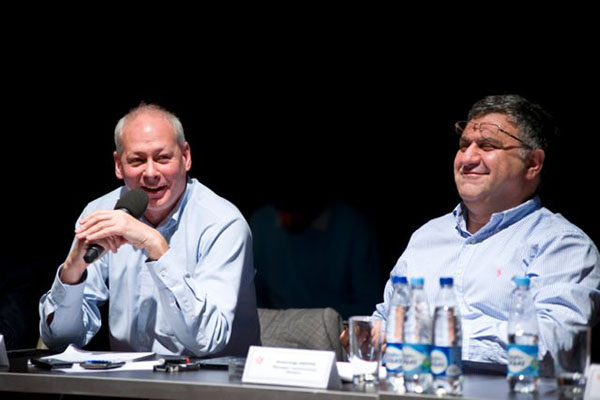 State Secretary and Deputy Minister of Culture Grigory Ivliev spoke about the new committee: «Right now it is important to understand which professions producers especially need, to set up a monitoring system in the field of film education, and to actively communicate with producers to help them overcome the staffing crisis. This is exactly what the industrial committee will be doing. For these purposes we are now inviting producers to cooperate.»
Deputy Minister of Communications and Mass Media Alexey Volin supported the initiative: «I am glad that my colleagues created such a committee. For our part, as the department also responsible for television, we are ready to contribute to the development of this area within the framework of the Ministry of Culture. As for education in the industry, I like the idea of building a multi-level system. It must be built with the participation of three indispensable sides — the state, the industry and responsible students interested in acquiring a profession. The state alone, without help from the industry and committed young people, will solve nothing.»
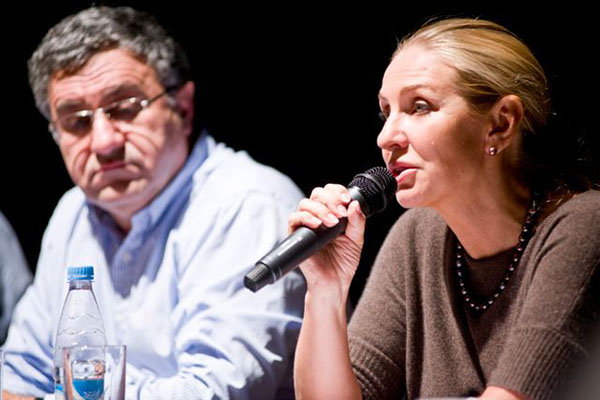 Anna Krutova adds: «Very many young people would like to link their lives to cinema. Now, with the support of the Association of Film and Television Producers — and, I emphasise, at the initiative from below — MOSSKiTT is being created. It is a youth organisation that brings together specialists in film, television and theatre. It already has 300 members, and more than 2,000 applications are currently being considered. That is why I am confident that the prospects for the direction we are talking about today are enormous.»
The President of Amedia and Chairman of the Board of the Association of Film and Television Producers Alexander Akopov spoke about the issues facing the industry: «There are simply not enough film school graduates, especially in quantity. We produce 80 TV films and short series a year, 80 mid-sized series and 80 feature films. That is 240 projects stretched out over an average of two years. And for each of these projects we need producers, editors, directors, writers, huge numbers of technical specialists, not to mention actors. On top of that, television makes talk shows, documentary films and other programmes, providing 24/7 broadcasting. Because of the lack of personnel, every decent writer we have is working on five projects, and it is often impossible to have a normal working relationship with them, since they understand they lose nothing — they have a queue of projects. In the American industry, for example, eight unemployed people compete for one job. And the picture is completely different. With today's production volumes we need five to seven universities at the level of VGIK and 200 technical educational institutions.»
«Another problem,» continued Alexander Akopov, «is the focus of today's graduates on auteur cinema. The training system is not oriented to the Viewer (a word we at our company make a point of writing with a capital letter). That is why we have to turn to the experience of Los Angeles, where they teach that all film professions are based on such a discipline as dramaturgy. It is this discipline that allows one to answer the questions a Viewer usually asks while watching a film. Unfortunately, this discipline is not taught here, though everyone knows the Kuleshov effect.»
The General Producer of PROFIT Igor Tolstunov agreed with his colleague: «It is important to have more practice, so that during their training the students themselves shoot three to five short films a year. Otherwise we are faced with the task of re-training what are supposedly already trained specialists at our studios and with battling their infantilism.»
VGIK Vice-rector Viktor Zuikov lamented that, acting within the framework of the law, VGIK admits 17-year-old students who do not really know whether they will work in their chosen profession. Moreover, teaching methods have to be agreed with the Ministry of Education and it is not at all easy for a state university to introduce new traditions. However, a paid Centre of Supplementary Education has already been opened at VGIK, where 200 students aged 25 and over study.
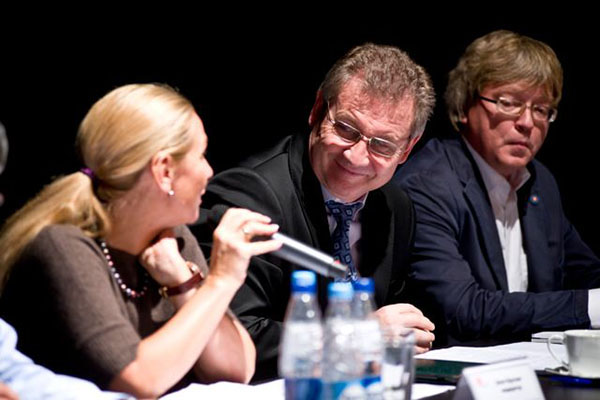
Representatives of private film schools (Cinemotion, Kultburo, Moscow Film School, Moscow School of New Cinema, Free Cinema, Alexander Mitta Film School) shared experience of building a private business in film education, which is genuinely in demand among young people. On their part, they recommended designing a grant system for talented students so that they could continue to develop in their profession.
Anna Krutova summed up all the presentations at the round table. She assured the attendees that the Association of Film and Television Producers has taken education issues seriously and intends to establish a grant in support of talented students, actively work in the industrial committee at the Ministry of Culture, adapt the teaching methodology of Hollywood's USC school, support private film schools and organise refresher courses for the teaching staff.